Monday, November 7, 2011

Stephanie Price submits Keliy Anderson-Staley


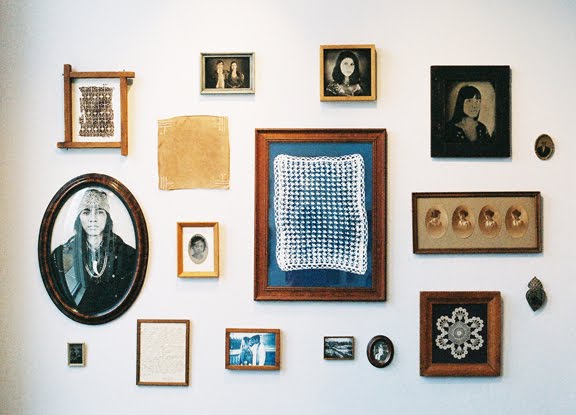
I was researching ideas for my tin types when I came across artist Keliy Anderson-Staley. She uses a wet plate collodion process ( artist shown coating plates above) with her 4x5 camera. This is a process that was popular in the 1850's. Her Imagined Family Heirlooms series (shown above) made me think of our project Cabinet of Curiosity. She has assembled photos(tin type) and objects she has collected to create this almost eery assemblage of a family's history. Its an interesting modern take on the technique and the collection of this imaginary family is very interesting, makes me re-think my cabinet of curiosity and how much more depth my images could potentially show.

http://www.andersonstaley.com/

Saturday, November 5, 2011

Abigail Marquez submits Christina Z. Anderson


Christina Z. Anderson works with alternative processes as a form of art, including gum bichromate. While doing some research on the process for our own assignment, I had the opportunity to look through some of her work.

Her prints convey emotion and humor through composition, but more so, through her handling of the tricolor gum bichromate, sometimes starting with a layer of cyanotype for a full color print. The concept behind the images in the Gender Vanitas series is clearly represented with this process, allowing for humor, irony, and a sense of antiquity behind a stereotypical culture. This is a great example of what can be achieved with the split process in gum, rather than monochromatic prints.

Thursday, November 3, 2011

Katy Schmader submits Alicia Ross


Alicia Ross works with photographic imagery and than pushes and pulls the image within the boundaries of cross stitch patterns. I love the way her work plays with the medium that she has chosen.

The images plays with the idea of what she calls the domestic female versus the idealized sexual woman of desire. In her work Ross plays with the boundary of these two roles by intertwining fine art with pornographic image to distort our ideas of the role.

I looked at these images due to my interest in work with embroidery. The techniques she uses when working within cross stitch really work, and it is a great example of what the medium can do.

Pako presents Peter Beste


Peter Beste is, as far as I am concerned, the only photographer who has captured the essence of what Black Metal is. Beste's photograph give a little glimpse of what the people performing and creating this genera of music look when they bring to reality their persona. In the Black Metal community the photographs often fall into the silly and humorous, while trying to appear really sinister and grim.

Beste's choice of location for some of the photographs is dead spot on with what the subject matter is usually for this genera of music; which involves a close relationship with religion, desolation, anguish and Norway's landscapes. Another aspect of Beste's photography I found really interesting, is how in some of his photographs there is a random element that works very well with the composition, and makes it even more interesting.

www.peterbeste.com


Andrea Couture submits Dan Burkholder


Dan Burkholder is an artist working with alternative processes. The above photos are examples of his platinum prints. The first one is pigment over a platinum print and the second is platinum over gold leaf.
When creating the pigment over platinum prints he combines the process of platinum printing with digitally applied archival inks. The platinum part of the gold leaf prints are printed on a very translucent vellum paper. Burkholder then applies gold leaf to the back of the paper so that all of the highlights in the image are the reflective gold of the gold leaf. Both of these techniques produce very rich prints and I have a feeling the web images don't do them justice.
Even though Burkholder is mainly taking landscape photos, he ends up with images that are very rich and ominous. The saturated color of the platinum printing comes to life with the different techniques that Burkholder uses. Another aspect that gives the images a sense of ominousness is Burkholder's use of focus, depth of field, and exposure time.

Here is his website:

Andrea Couture submits Blue Mitchell


Blue Mitchell is a photographer that Libby suggested I look at. All of the images above are from his "Mythos" project, but I suggest looking at his other work too. This work has a dream like quality to it and shows the early moments in an experience. After Mitchell has composed a photograph he uses a transfer process and adheres his image to wood panels. After attaching his photo to the wood he covers the image in a gloss, then leaves it as is, without a frame. This process definitely enhances these images and I would love to see them in person. The care Mitchell takes with each image is definitely apparent in his final pieces. There seems to be a sense of importance with each piece. I feel that this is an important aspect to this body of work because these beginnings of experiences become very important pivotal moments.
These images definitely inspire me to keep working with my "Other Worldly" project.
Thanks for the suggestion Libby...I'm in love with this work.

Here's his website:

Wednesday, November 2, 2011

Jason Rudd/ Robert and Shauna ParkeHarrison


This is my first blog post,EVER. I absolutely love these surreal images,which by all means is my cup of tea. The pair are collaborating together by displaying our shattering world with dreamlike surreal images. These convey loss and human struggle which by all means I can identify with. These human conditions are intertwined with that of landscapes scarred by technology. These images are constructed by photomontage and painting techniques. As a Dali enthusiast I enjoy finding Surrealism in the form of photography as well. They are manipulated beautifully and sincerely convey their narrative in such a powerful manner. -End