Tuesday, November 8, 2011

Rebecca Villarreal presents Bill Dewy


Bill Dewy is an aerial photographer who approaches his photos with a painter's touch. Many of his photos look as if he took a giant paint brush created a composition and photographed it. All his photos have sweeping lines that translate in to brush strokes that were not smoothed out before they dried. Each photo seems to be a composed of a study of lines and texture. All of the lines in his work create a since of movement that allows the eye to travel the image a million times over. His use of texture is phenomenal too, looking at his photos you almost want to try to sweep your hand across the image to see if you can feel the prickly sensation of the hay. The other great thing about his photos are the colors, all his yellows are rich and his blues deep. He is some one to look at if you are interested in landscape photography.

Monday, November 7, 2011

Abigail Marquez submits John Coffer


John Coffer is a traveling wet-plate artist who has been working with this medium since 1978. He began his work in a 19th century style darkroom wagon named the "Photographic Van" and crossed the country doing traveling portraits. Since then, John Coffer has moved on from using dry plate tintypes to using the wet-plate collodion process and has been giving workshops throughout the United States since 1996.

His work possesses a quality of antiquity represented by the medium as well as the subject matter, focusing on imagery from the old time country in the 19th century.

Gabriellena Weidanz submits Helene Schmitz


Helene Schmitz is a contributing photographer for National Geographic. She is known for her vivid, brightly colored photographs of flowers against a black background. Currently she lives in Stockholm and she was the first woman to be awarded the Swedish Environmental Agency's Nature Photographer of the Year award.

Gabriellena Weidanz submits Elena Kalis


While researching for ideas for photography and other art projects, I came across Elena Kalis' webpage and found it quite whimsical and interesting. Her biggest inspiration for this project is the Ocean. She describes the ocean as being "vast and multifaceted. One day it is bright, sunny and fun. Yet there is another side which is darkness, unconsciousness, death. I can never get tired from it and it is my main daily dose of inspiration.” She definitely creates awe- inspiring images!


Abigail Marquez submits Teresa Van Hatten-Granath


Teresa Van Hatten-Granath works with digital imaging as well as alternative processes, including cyanotype and gum bichromate prints. Although most of her work is digitally based, I find interesting the way she combines the use of computer and traditional skill, through this medium. Although her images are composed digitally, imagery is also integrated into her prints through scanning.

I find myself drawn to her work through her use of the human body, most often female, where it is often centered and then surrounded with other imagery. The color choice for her compositions seem to really affect the "natural" feel of her prints, as they most often are a combination of primary colors and the nude body.

Stephanie Price submits Laura McPhee


When I was attending the SPESC conference this fall i had the chance to catch Laura McPhee's discussion of her work, River of No Return. What I found the most interesting is that i was so drawn to her landscapes. Usually i see a landscape and i walk right by but as she showed and talked about her photographs of this beautiful scenery, i couldn't help but to stare. They seem to speak more than just how beautiful the land is, its almost as if she captures the scenery in a way that it can speak to us not just in beauty but something more. I especially love the image of the frozen dead fish in the water these are defiantly images i can refer to for my personal project which deals with water and reflections.
http://www.lauramcphee.com/ronr.php

Stephanie Price submits Keliy Anderson-Staley


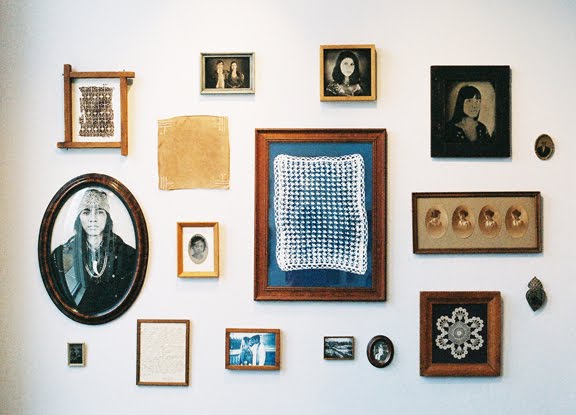
I was researching ideas for my tin types when I came across artist Keliy Anderson-Staley. She uses a wet plate collodion process ( artist shown coating plates above) with her 4x5 camera. This is a process that was popular in the 1850's. Her Imagined Family Heirlooms series (shown above) made me think of our project Cabinet of Curiosity. She has assembled photos(tin type) and objects she has collected to create this almost eery assemblage of a family's history. Its an interesting modern take on the technique and the collection of this imaginary family is very interesting, makes me re-think my cabinet of curiosity and how much more depth my images could potentially show.

http://www.andersonstaley.com/